July 12, 2021

STUDY OF PSALMS - Chapters 17-20

PSALM 17 - “Who is Innocent?”

(Prayer of David)

[Psalm 17 is one of only five with the title “A prayer of David”. It is essentially a prayer for protection.]

Vs. 1-5 – David feels he is being unjustly persecuted and presents his case before the only One who can declare him righteous... the Heavenly Judge who “tests” our hearts.

πŸ’›NUGGET:  Jesus – the only one who was ever truly innocent – never defended His own innocence. Instead, He allowed Himself to be charged “guilty”, so that we – the truly guilty ones – could be called saved.

Vs. 8 – “The Apple of your Eye” and the “Shadow of your Wings” are powerful pictures of God's care and protection for His people.

Vs. 14 – David's lament is against men who belong to the world and are “satisfied” with their portion in THIS life only.

Vs. 15 – Contrasted with verse 14, David looks forward to his eternal portion and will be “satisfied” when he awakens to look upon the face of God. 

Our ultimate satisfaction is found in the life to come.

πŸ’›πŸ’›πŸ’›

PSALM 18 - “Blessed Be My Rock”
(Royal Psalm of David)


[This superscription contains more information than any other psalm. As well as being a Royal Psalm, it is a Praise Psalm. Though unspecified, it is set against the backdrop of a military victory where God fought for David and delivered him from his enemies “and from the hand of Saul”.  (Interesting glimpse into the heart of David that he did not list Saul among his enemies.)  It should also be noted that this psalm is also recorded in the parallel scriptures of 2 Samuel 22.]

Vs. 1-2 – David's Divine Metaphors (describing God in military terms):
  • Rock
  • Fortress
  • Deliverer
  • Shield
  • Horn of my Salvation 
  • Stronghold
Vs. 9-17 – God came down in a blaze of glory riding on a chariot of cherubs hurling fire and hailstones. Sorta reminds me of that old 70's margarine commercial about fooling Mother Nature.  And if it's not nice to fool Mother Nature, it's downright crazy to anger Father God!

Vs. 19 – God rescued David because He “delighted” in him.  How amazing is it to know that God delights in us, too!  Want to know how much God loves you? Just count all the times He has delivered you from sin and the darkness of evil.  He is crazy about you!

Vs. 46: The Lord liveth! And blessed be my Rock, and let the God of my salvation be exalted... let's sing it!


πŸ’›πŸ’›πŸ’›

PSALM 19 - “Sermon of the Stars”
(Creation Hymn of David)

Vs. 1-4 – “The heavens declare the glory of God...” Day and night without ceasing, the sermon of the stars go out to the end of the world, revealing God's presence and glory. Everyone receives it. Not everyone accepts it. The Apostle Paul explained it best in Romans 1, stating that all men are “without excuse” if they choose to reject the magnificent and overwhelming evidence of God through His creation.

Vs. 7-9 – In an abrupt shift from extolling the wonders of God's creation, David suddenly turns his attention to the “instruction of the Lord”. What's the connection? God not only reveals Himself through His creation, He also reveals Himself through His Word. We can't fully know God without knowing His revealed Word. And both - His creation AND His Word - inspire worship and awe...


In case you didn't notice, verses 7-9 are chock full of Hebrew poetic parallelism...

SIX characteristics of GOD'S WORD:
  • The law of the Lord
  • The testimony of the Lord
  • The statutes of the Lord
  • The commandment of the Lord
  • The fear of the Lord
  • The judgments of the Lord
SIX benefits of GOD'S WORD:
  • Renews the soul
  • Makes the simple wise
  • Makes the heart happy
  • Makes the eyes light up
  • Endures forever
  • Warns God's servant
SIX attributes of GOD'S WORD
  • Perfect
  • Sure
  • Right
  • Pure
  • Clean
  • True
Vs. 10 – After describing God's Word, David goes on to tell us the value of God's Word is more valuable than fine gold. (I told you there were nuggets!!πŸ’›)

πŸ’›NUGGET: The “GOLD” in God's Word comes from having value not ONLY in this life, but for our eternal lives, hereafter. “In keeping them there is an abundant reward.”

Vs. 12-13 – David's goal is to be blameless, just like His Creator. He specifically asked God to cleanse him from two types of sin:
  1. HIDDEN (unintentional; unseen by the sinner)
  2. PRESUMPTUOUS (intentional; deliberate)
Vs. 14 - David offers his words of worship before God as a sacrifice. God ultimately answered David's prayer with Jesus... the final fulfillment of both creation and the Law.


πŸ’›πŸ’›πŸ’›

PSALM 20 - “Save, Lord!”
(Royal Psalm of David)

[When reading this psalm, I picture King David's people gathered around him at the tabernacle to offer sacrifices and prayers before going out to war. Historically, many scholars link this psalm with David's battle against the Ammonites and Syrians (2 Samuel 10).]

Vs. 1-3 – The people pray that God will provide King David protection and help from the "sanctuary" on Mount Zion.

Vs. 4-5 – We can be confident that God will give us our desires and purposes when they are in alignment with His will and plan.  The worshippers are so sure of victory that they're ready to lift up their banners in joyful celebration and give God the glory.

πŸ’›NUGGET: In Exodus 17:15, Moses identified the Lord as Israel's banner.

Vs. 6 – This is a singular response, likely from David or the High Priest on his behalf. Although the people prayed that help would come from the earthly sanctuary on Zion, the speaker in this verse understands that victory comes from the Lord's Heavenly Sanctuary.

Vs. 7-9 – Again, the people respond collectively. They do not put their trust in chariots or horses, but in the Lord. How tempting it is to trust in our mighty military power or even political power to protect us from our enemies. But in this world, we fight not only flesh and blood but against spiritual forces of evil.  Lord, save!

This is the language of faith, 
not after the battle, but before it.” 
(G. Campbell Morgan)

πŸ’›πŸ’›πŸ’›

READING FOR TOMORROW:  Psalms 21-25

LINK TO READING PLAN:
https://bibleplan.org/plans/psalms-in-a-month/

July 11, 2021

STUDY OF PSALMS - Chapters 11-16

PSALM 11 - “Fight or Flight”
(Lament of David)

Right outta the chute we learn that David is being pursued by wicked men who are trying to kill him "from the shadows”. His friends tell him to run for the hills “like a bird”. Instead, David chooses to take refuge in the Lord. Undoubtedly, his friends were well-meaning in their attempts to keep David safe. What they didn't understand is that only God could provide the safety and refuge David needed.

Vs. 4 – Just as the Lord was watching over David from His Heavenly throne over 3000 years ago, so is He with us, today. Earthly kingdoms rise and fall but God is unmovable.

Vs. 5 – The Lord tests the righteous (to prove their faith) and protects them.

πŸ’›NUGGET: Today, we are inundated with warnings from modern-day prophets of doom, advising us what we must do to survive the crisis of the moment. In this psalm, David reminds us that our true refuge will never be found in this world.

πŸ’›πŸ’›πŸ’›

PSALM 12 – “Pure Words”
(Community Lament of David)

[“Sheminith” in the superscription means "the eighth" in Hebrew, usually interpreted to mean either an eight-stringed instrument or a musical octave.]

Vs. 1-2 – David's complaint (lament) to God is that faithful men were hard to find while the wicked surrounded them. (Are you figuring out that things haven't changed much since David's time?) 
“They speak vanity every one with his neighbor: with flattering lips and with a double heart do they speak.”
In other words, they were Dishonest, Double-Hearted, Deceivers causing Division.

[The meaning for speaking with a "double heart" in Hebrew is literally, “by a heart and a heart they speak” . They say one thing, but mean another.]

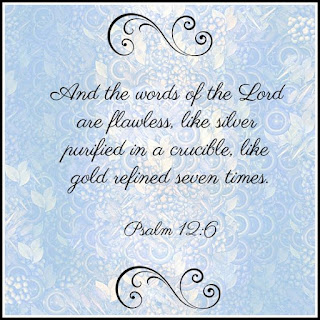
Contrasted with the totally unreliable word of wicked men is the absolute reliability of God's Word.  His words are flawless, trustworthy and more pure than the purest silver.


πŸ’›NUGGET: In the Bible, the number 7 represents completeness and perfection. Therefore, God's Word is flawless, trustworthy and perfect. It can withstand any test of purity and has withstood the test of time. As we are in His Word, we will be purified.

Vs. 8 – In our fallen world, sin is pervasive and exalted, but we can find refuge in God's sovereign protection. 

πŸ’›πŸ’›πŸ’›

PSALM 13 – “Lighten My Eyes”
(Lament of David)

Sometimes it feels like the enemy is winning...

In this song, the question “How Long?” is repeated FOUR times. David is not so much seeking an answer for his suffering as he is expressing frustration. He prays that God will “lighten” his eyes, imploring Him to strengthen his faith, give him encouragement and refresh his soul. (1 Samuel 14:27, 29; Ezra 9:8).   David needed some sparkle back in his eyes.

Vs. 5 – A big change in tone happens here... David's sorrow turns to singing. His prayers become praise. Once again, David puts his trust in God's “faithful” (chesed / hesed) love, the covenant love that fills him with a confidence in God's salvation.

The steadfast love of the Lord outlasts all our enemies.

πŸ’›πŸ’›πŸ’›

PSALM 14 – “What a Fool Believes”
(Community Lament of David)

[This psalm is almost identical to Psalm 53.]

Vs. 1 – “The fool says in his heart, There's no God.” 

The Hebrew word for “fool” is nabal. It describes a person with a 'heart' problem more than a 'head' problem. Unless one is omnipotent and omniscient, it is impossible to deny the presence of God. Therefore, to say “there is no God” cannot be a statement discerned by intellectual process, but rather based on "feelings".  Denial comes from a heart unwilling to accept a Sovereign Being with the power to mete out punishment or reward. The “fool” lives their life without acknowledging God, both in a spiritual and moral sense.  David goes on to observe that there is really “no one” who does good in the sight of God and that all (excluding him) are corrupt. We would like to write his words off as hyperbole, since this is the same guy who told us his bed was swimming back in Psalms 6:6... but then, there's that pesky Apostle Paul preaching about the same “fools” in Romans 1:21-22:
...Because, although they knew God, they did not glorify Him as God, nor were thankful, but became futile in their thoughts, and their foolish hearts were darkened. Professing to be wise, they became fools.
He takes it a step further in Romans 3:11-12:
There is none righteous, no, not one; there is none who understands; there is none who seeks after God. They have all turned aside; they have together become unprofitable; there is none who does good, no, not one.
Then, gives us the reason for foolish unrighteousness in 3:18:
There is no fear of God before their eyes.”
Let's be honest... aren't we all just a bunch of sinful fools, sometimes? As Pesky Paul points out, no person – no, not one – can claim righteousness apart from the Spirit of God and through faith in Christ Jesus.

Vs. 7 – The song concludes with a prayer that communal salvation will come from Zion 
(God's Holy Mountain).

πŸ’›πŸ’›πŸ’›

PSALM 15 – “Who Can Dwell with God?”
(Psalm of David)

This is a Wisdom Psalm, which are also called Didactic Psalms (teaching or instructional in nature). Many scholars believe this psalm was likely prayed by the Israelites as they made their pilgrimages to the temple during Holy Days.  So, where Psalm 14 ended with a longing for salvation to come from Zion, this is a psalm that was sung on the way to Zion. 

THE QUESTION:
Who can dwell with God?

THE ANSWER:
One who walks blamelessly and does what is right
One who speaks truth in his heart;
One who does not slander with his tongue
One who does no evil to his neighbor,
One who does not take up a reproach against his friend;
One who despises a vile person,
One who honors those who fear the Lord;
One who keeps his promises, even if it causes him pain;
One who does not lend out his money at interest
One who does not take a bribe against the innocent.

THE BLESSING:
The one who does these things will not be shaken.

And the world is passing away, and the lust of it; but he who does the will of God abides forever.” (1 John 2:17)

πŸ’›πŸ’›πŸ’›

PSALM 16 - “Up from the Grave He Arose!”
(Messianic Psalm of David)

Vs. 1 –  David   prays  for  God's protection  even  as  he claims God as his refuge.   But wait...  if God is his refuge, isn't David's safety ensured?  Yep.  I've done it, too.  Sometimes it's hard to accept that God's  "refuge" may  be eternal, rather than temporal.  Our imperfect faith creates a needless tension between heaven  and earth.   Only Jesus  had  perfect faith  in  God's eternal promises.

Vs. 2 – “You are my Lord; I have nothing good besides you.” This beautiful statement right here is why God loved David so big. David embodied the guy he described in Psalm 15. Mostly. Except for that little incident with Bathsheba.

πŸ’›NUGGET: When we surrender all to God, we end up with everything.

Vs. 8-11 – The psalm changes from a prayer to what becomes a Messianic Prophecy about the resurrection of Jesus. While David is expressing great joy and hope for the future and that his “body would rest securely”, Peter uses these same verses at Pentecost in reference to Christ (Acts 2:25-31). Paul also cited verse 10 stating, “For David, after he had served his own generation by the will of God, fell on sleep, and was laid unto his fathers, and saw corruption: But he, whom God raised again, saw no corruption” (Acts 13:35-37).

[Keep in mind that God was counseling David “day and night” (vs. 7) and David also received knowledge through the OT books and prophets. David, himself, was a prophet.]

πŸ’›NUGGET: God is our refuge in life (vs. 1-8) and our hope in death (vs. 9-11).


READING FOR TOMORROW:  Psalms 17-20

LINK TO READING PLAN:
https://bibleplan.org/plans/psalms-in-a-month/


July 10, 2021

STUDY OF PSALMS - Chapters 6-10

PSALM 6 - “How Long O Lord?”
(Lament of David)

This is the first of seven Penitential Psalms - songs of confession and humility before God. It was a custom among some in the early church to sing these psalms on Ash Wednesday. Some scholars consider this only a Lament, as no indication of sin is directly mentioned.

[Psalm 6 is a gift of prayer for our darkest nights of ugly crying.  Cause who hasn't cried til the  bed is a'swimming in tears?]

Vs. 1-4 – Believing that his suffering is the result of God's discipline, David cries out for mercy for the sake of God's steadfast love.

The Hebrew word used for love is “chesed” or “hesed” and describes not only a steadfast or faithful love, it is a covenant love based on promises. There is no exact English equivalent for this word. David was clearly appealing to God from within His covenantal relationship. The Lord's “hesed” will never let us go. The fullness of His “hesed” - God's original covenant - was seen on the cross. We can cry out to God in confidence that nothing will separate us from His faithful, steadfast, loyal, sanctifying love.

Vs. 3 – Jesus used these same words to describe his anguish (John 12:27) but unlike David, He knew His suffering would bring God glory and salvation unto all who believe.


Vs. 9 – “The Lord has heard my plea... the Lord accepts my prayer.”

πŸ’›NUGGET: Because of His steadfast, covenantal love, God hears us even in our darkest times. He gives hope to our hopeless hearts. Prayer changes everything!

πŸ’›
πŸ’›

PSALM 7 - “Song of the Slandered Saint"
(Lament of David)

The superscription identifies this psalm 7 as a Shiggaion of David, “which he sang unto the Lord concerning the words of Cush the Benjamite.” NKJV translates "shiggaion" as a meditation. Cush the Benjamite was a relative of Saul and apparently an enemy of David.

As David is pursued by his enemies, he declares his innocence to God as a Righteous Judge. Charles Spurgeon called this psalm, "the song of the slandered saint."

Vs. 6-8 – David's call for God to bring judgment upon his enemies causes this hymn to also be classified as an “Imprecatory Psalm”. Imprecation is calling down God’s anger and judgment on one's enemies. These psalms were not written out of vindictiveness, but are prayers asking God to provide justice and protection.

πŸ’› NUGGET: Notice in vs. 12 that God's bow is bent. The arrow is in place. What then, is holding back His divine judgment and punishment? One word: Mercy. Better yet, two words: Undeserved Mercy.

Vs. 14 – Sin is conceived from within and given life BY the sinner, just as a mother gives birth to her children.    (And I ain't gonna lie... those sin babies are U-G-L-Y !)


πŸ’›
πŸ’›

PSALM 8 - “What is Man?”
(Praise hymn of David)

This psalm is also a Creation Hymn – focuses on earth & the heavens. It begins and ends by extolling the majesty of God. The chapters in between show the tension between His Majesty and Glory and our lack, thereof.

Vs.2 - ”From the mouths of babes”... Jesus chided His accusers with this passage in Matthew 21:15-16. Just as infants and nursing babies give testimony to God with their simple faith (8:2), so were the children able to recognize Jesus in the temple with shouts of “Hosanna to the son of David!”.

Vs.4-6 – Quoted in Hebrews 2:6-9 as being ultimately fulfilled in Jesus. The Majesty of Heaven came down to earth as a lowly man, but was eternally crowned with Glory and Honor.

Vs.5-8 – Essentially a commentary on Genesis 1:26-28

Psalm ends in “inclusio” (ends as it begins, creating “bookends”)

πŸ’›

πŸ’›

PSALM 9 - “Here Come da Judge”
(Thanksgiving / Praise Hymn of David)

While most believe the title “Muth-Labben” (found in the superscription) refers to a tune, others suggest that it refers to an instrument upon which the song was played. NKJV associates it with the phrase “The Death of the Son” corresponding to the ancient Chaldee inscription which states: “Concerning the death of the Champion who went out between the camps,” referring to Goliath.  This song describes the Lord coming to the rescue.

In the original Greek and Latin versions, Psalms 9 and 10 are joined as one song. Together they form a partial alphabet acrostic and both psalms praise God in the role of a good Judge. But there are differences that justify their separation. Psalm 9 focuses on Thanksgiving while Psalm 10 is more of a Lament.

Vs. 8 – 1000 years after David's writing, the Apostle Paul quoted this verse to the Christians in Athens in speaking of Jesus: “He shall judge the world in righteousness.”  (Acts 17:31).

Vs. 14 – Daughter Zion = Jerusalem (referring to both the city and its inhabitants)

πŸ’› NUGGET:  There is a play on words in vs. 17-18 with “forget” and “forgotten” where David illustrates a contrast between the wicked who forget God and those who are oppressed, yet never forgotten by God. 

πŸ’›

πŸ’›

PSALM 10 - “There Is A God”
(Lament)

Although this psalm is untitled and shares some similar themes with Psalm 9, it is able to stand on its own as a song decrying the prosperity of the wicked but ultimately trusting in the righteousness and sovereignty of God.

There is not, in my judgment, a Psalm which describes the mind, the manners, the works, the words, the feelings, and the fate of the ungodly with so much propriety, fullness, and light, as this Psalm.” (Martin Luther)

Vs. 4 - The wicked believe that since they are not held accountable, there is “no God”. This type of denial of God is “practical atheism” - denying that God pays attention. “Metaphysical Atheism” is an absolute unbelief in God's existence


Vs. 17-18 – Notice David says God has heard the “desire” of the humble, rather than their “prayer”. Sometimes, we are unable to put our desires into words.  Or perhaps we don't feel worthy to bring them to God. But God listens carefully and hears even our unformed prayers.

πŸ’› When my oldest son, Lucas, was 3 and I was 7 months pregnant with my second son, we were in a horrible car wreck. It ended up being a 6-car pileup, including the semi who hit my side of the car and turned it into a twisted heap of mangled metal. I lost consciousness briefly and had a small skull laceration. Lucas had a few tiny scratches from broken glass and Jacob – in utero - never stopped kicking. We were taken by ambulance to the ER and I received stitches in my head. The doctor deemed it wise for me to stay overnight for observation. As I was being wheeled from the ER to my hospital room, I looked up to see that the halls were lined – literally lined – with friends and family who had come to check on us (small town love, y'all). When everyone finally left and I was alone in my bed, I knew I had to somehow find the words to thank God for saving our three lives. But the words wouldn't come. Hard as I tried, there were just no words big enough or holy enough to express my overwhelming gratitude. As I lay in humble stillness, I lifted my hands in supplication, silently begging God to reach into my heaped up heart and understand the depth of my love and thankfulness.  Tears streamed down my face and peace flooded my soul as He listened to the desires of my heart.


READING FOR TOMORROW:  Psalms 11-16

LINK TO READING PLAN:
https://bibleplan.org/plans/psalms-in-a-month/

July 09, 2021

STUDY OF PSALMS - Chapters 1-5

Book 1 of the Psalms traditionally includes Chapters 1-41, but there is a growing consensus among biblical scholars that Chapters 1 and 2 stand alone as an introduction or prelude to the entire book. Chapters 1 and 2 are both untitled and are likewise bound together with the word "blessed", which opens Chapter 1 and closes Chapter 2.   In essence, they establish the basic theology for the rest of the book.

____________________________________________

PSALM 1 – “Who Is Blessed?”

Blessed” in this reading is more aptly translated “happy”, as distinguished from the Hebrew word usually translated for "blessed".

In this song we are told that in order to be blessed, we must avoid three things:

  1. Walking with the wicked
  2. Standing with sinners
  3. Sitting with scoffers

Did you notice the progression from walking to standing to sitting? Seems to me the comfort level increases in direct proportion to the amount of time spent hanging out with the wrong people on the wrong path. As this psalm clearly states, there are two distinct paths. One way (following the Lord through His WORD) leads to blessing and the other leads to ruin. The difference is where you plant yourself. Location. Location. Location.

πŸ’›NUGGET: Plant yourself by the Living Waters (John 7:38) and you will flourish. 

 Choose your path wisely.

____________________________________________

PSALM 2 - “Kiss The Son”

This Psalm is basically a poetic reflection of 2 Samuel 7:16, where God promises David that his throne will be established forever.

In Psalm 1 we learned about two different types of people (wicked vs. blessed). Psalm 2 is about two different types of kingdoms or nations (rebellious vs. submissive).

Psalm 2 is a Messianic Psalm. This means that somewhere within the psalm, a reference is made about the Messiah who is to come.

Vs. 1-2 describe the nations of the earth raging in rebellion against God's “Anointed One”. The word “anointed” is translated into Greek as Christos (Christ) and in Hebrew as Messiah.

Although no authorship of this psalm is identified, it is attributed to David in Acts 4:25-26, where we find the early church praying this psalm as they faced persecution.   In fact, Psalm 2 is the most quoted psalm in the NT.

Under the inspiration of the Holy Spirit (the true author), David wrote this psalm not only about himself, but even more profoundly about Jesus. Just as kings and nations rebelled against King David, they continue to do so against the Heavenly King.

What?!  Rebel against the King of Kings? It's laughable! At least it was to the Omnipotent God in vs. 4. 

The structure of this psalm goes something like this:

  • Vs. 1-3: Rebellion is a' brewing in the kingdom.
  • Vs. 4-6: Wanna make God laugh? Try rebelling against His King.
  • Vs. 7-9: God and Jesus talk amongst themselves: Jesus is King
  • Vs. 10-12: Wise up you royal knuckleheads. Kiss the Son.

πŸ’›NUGGET: The dialogue in verses 7-9 gives the only OT reference to the Father/Son relationship in the Trinity. Verse 7 is quoted in the NT in regard to the birth of Jesus (Hebrews 1:5-6) and also in Acts 13:33-34 discussing the resurrection.

This psalm ends where Psalm 1 begins... offering happiness for those who trust God.  

____________________________________________


PSALM 3 - “Lifter Of My Head”
(Lament of David)

[There is a “superscription” before some of the Psalms, which is a statement describing the historical setting of the psalm or a specific note regarding the music. The superscription before Psalm 3 states “A psalm of David when he fled from Absalom his son.”]

This psalm is classified as a Lament. Over 1/3 of the psalms are Lament Psalms which fall under the category of a Basic Structure:

  • “I'm gonna complain to God!”
  •  “And here's why I'm complaining!”

Or a Complex Structure:

  • Lament (Complaint)
  • Petition (Request for help)
  • Affirmation & Praise to God

Laments begin with complaining but usually end up in faith and praise.

Per the superscript, Psalm 3 is linked to events in David's life when he was forced to flee from his hairy son Absalom as recorded in 2 Samuel chapters 15-18. His son had turned against him, his enemies were increasing in number, David's life was falling apart, so what did he do? He wrote a psalm... a prayer of petition to God.

πŸ’›NUGGET:  When David's focus shifts from himself to God (vs. 3), his worries melt away.  He takes a nap and wakes up with enough courage to face 10,000 enemies, because God is his Shield.

A note about “SELAH”: This word is used 71 times in the Psalms. I wish I could tell you definitively what it means, but other than assuming it refers to a type of musical notation or perhaps a cue to pause... the meaning is uncertain.

____________________________________________


PSALM 4 – "Night Prayer"
(Lament of David)

[This is the first psalm to have musical instructions to the choir.]

Vs.1 - David boldly calls out to the “God of my righteousness”. This particular way of addressing God is not used anywhere else in the scripture. It's personal. David is imbued with Holy Boldness because he knows his righteousness does not depend on the whims of men or even his own actions, but is instead a gift and reward from God.

Vs. 6 - During this time of chaos (which some scholars of the Psalms attribute to a famine), David prays that God would “let the light of His face” shine upon them all. 

πŸ’›NUGGET:  This prayer is very similar to the Aaronic blessing found in Numbers 6:24-26:


The Lord bless you and keep you;
The Lord make His face shine upon you,
And be gracious to you;
The Lord lift up His countenance upon you,
And give you peace.


And David slept in peace.

____________________________________________


PSALM 5 – "Shout For Joy"
(Lament of David)

At the end of David's peaceful rest in Psalm 4, he wakes up offering morning prayers in Psalm 5. And shouldn't we follow his example? “Give ear to my words, O Lord” should be the first words out of our mouths before the devil even realizes we're awake. And not only does David ask God to listen to his words, he also asks God to “consider his meditations”. The understood translation of “meditations” is a low murmuring or sighing. David has confidence that God (through the Holy Spirit) can understand and discern his innermost thoughts and silent prayers. This calls to mind Romans 8:26, "Likewise the Spirit also helps in our weaknesses.  For we do not know what we should pray for as we ought, but the Spirit Himself makes intercession for us with groanings which cannot be uttered." 

Vs. 9 - “Their throat is an open grave...” Yuck.  We'll just have to recognize that David's poetic license is at work here and trust that he's not describing a really bad case of halitosis. I wonder how David feels about Paul quoting his ugly metaphor in Romans 3:13 as evidence of the sinful condition of ALL people.

πŸ’›NUGGET:  In verse 4, David states that evil cannot dwell with God. In verse 7, he pictures himself entering the temple to be nearer to God. But the nugget is in verse 11. The literal Greek translation of “you spread your protection over them” (NIV) reads “you will make a nest among them”.  God comes close.  And therein lies the source of our JOY.

I leave you with this beautiful song, inspired by Psalm 3:

https://www.youtube.com/watch?v=-EBhr-3cr2E&t=3s


READING FOR TOMORROW:  Psalms 6-10

LINK TO READING PLAN:

https://bibleplan.org/plans/psalms-in-a-month/ 

July 08, 2021

STUDY OF PSALMS - Introduction


Psalm is a book of Hebrew poetry, prayers and praise. It is a collection of songs that run the gamut  of  human emotion...  ALL the emotions.   These expressions  of  the heart are appropriately located in the center of the Bible.  Often raw, always real, forever relatable.

It is different from all the other books of the Bible in that it is not a narrative, yet Psalm is full of prophecy and profound theology.  So much so that it is the most quoted Old Testament book by writers of the New Testament.  Jesus often referred to the Psalms in His teachings, even quoting them from the cross with His dying breath.

The name of the book comes from the Greek word, psalmoi, which means "songs"... specifically, songs that are sung to a stringed instrument (i.e. harp, lyre). The Hebrew title, Tehillim, translates to "praises".  It was written by at least seven different authors over a period of 900 to 1000 years, ranging from the exodus of Moses to the exile of Israel.  It was likely  during or after the Babylonian exile (around 500-400 B.C.) that the scrolls of all 150 Psalms were collected into their final form by Ezra and other religious leaders.  To the Jewish nation separated from their promised land and clinging to the promise of a new king, the finished Book of Psalms represented a hymnbook of HOPE  

Scholars are uncertain as to why the original manuscript of Psalm is divided into five books.  The division certainly isn't based on authorship or chronology, as there is often a lack of cohesive relationship between various chapters.  According to Jewish traditions, the division was created as a purposeful representation of the five books of the Torah (Genesis to Deuteronomy), foundational to the faith of Israel.

[Note of Interest:  At least 30 partial or complete manuscripts of the Book of Psalms were found among the Dead Sea Scrolls, the largest collection of any Bible book found there.]

In reading the Psalms, it helps to keep two things in mind: (1) they are ancient Hebrew poems set to music, and (2) ancient Hebrew poetry doesn't rhyme.  Instead of prose, the writers use "parallelism", a style which links ideas in order to show relationship between sequential lines of poetry.  

So... in a 150-chapter nutshell, we have a book filled with poems that do not rhyme, songs that have no music, joyful praises interspersed with heartbreaking lament... in no real order or easily identifiable structure.  And yet, the Book of Psalms remains one of the most beloved books of the Bible among both Jews and Christians.  The cherished hymns of old continue to sustain and renew our hope today, as we find refuge in the God of Moses and David while we wait for our King to return.  

I invite you to join me in this 31-day study of the Psalms.  Hopefully, we will gain a newfound appreciation of these scriptures as we find Christ - both anticipated and fulfilled - smack dab in the heart of our Bible.  

Here's a handy-dandy link to a reading plan (about 5 chapters/day) which you can also use to  send daily chapters to your email via the magic of the interwebs!

https://bibleplan.org/plans/psalms-in-a-month/

TOMMOROW:  Chapters 1-5


June 30, 2021

OUR BROKENNESS FOR HIS GLORY

My eyes can't believe the heartbreaking pictures I'm seeing of the apartment collapse in Surfside, Florida. The 'after' pictures of devastation - pancaked floors and mountains of rubble – are impossible to reconcile with the 'before' pictures of the beachfront condo. The twisted rebar and dangling sheetrock strips away all illusions of safety in things made by man.

It's not the first time our illusions have come crashing down and it won't be the last. Yet, we continue to see things as we want them to be, rather than how they really are. And each time, we are left flailing and grasping for air.

πŸ”΄

I'm in the middle of the book of Job. (God's timing, huh? 😬) I usually speedread through this particular book. I mean, who wants to read about a guy covered in sores who is trying to convince his friends that he's innocent after everything but his nagging wife has been taken away? But I'll be danged if the Spirit didn't decide to flat out wreck me with these scriptures, showing me how delusional our illusions have become.

We typically view the story of Job as a complex lesson in suffering, which isn't entirely wrong... suffering is indeed complex. We are escorted into a world of suffering the second we leave the womb. Suffering is inevitable, no one escapes. But in God's plans, suffering is a means to an end. The overt lesson of Job is not about suffering... it's about SOVEREIGNTY.

I get it. I understand why Job and his helpful friends spent days questioning God's purpose. I might even know *ahem* someone who has indignantly demanded answers from Heaven for perceived injustices. That same *ahem* person may also be guilty of arrogantly offering suggestions for running the universe to The Very One Who Put The Stars In Place.

In our humanity, we cry out for a rational understanding of an Omnipotent God. It's hard to reconcile the Creator of hummingbirds with the same God who allows incomprehensible suffering to innocent people. But He is the same. We are told so in the very first chapter of Job. Not one thing happens on this planet that God has not allowed. We serve a sovereign God.

It is in our suffering that we are most likely to forget His Sovereignty. In our brokenness and despair, we need to be reminded that His ways are not our ways... His thoughts are not our thoughts (Isaiah 55:8).

All we can know is what He wants us to know.

Read that again. It's a difficult concept to those searching for eternal meaning in a broken and finite world.

We would rather trust in the things we can see. Things like 12-story buildings. Politicians. A 24-Hour News Cycle.

God couldn't be trying harder to show us how far from Heaven our trust is misplaced. In fact, His Word tells us that we can only be certain of things we DON'T SEE (Hebrews 11:1). It is our faith that makes the unseen things real. And sometimes, when it looks as though things are falling apart... that same faith ensures that everything will eventually fall together.

And though my human knowledge and reasoning are pitifully inadequate, this I know for sure... that “the same Spirit of Him who raised Jesus from the dead is living me” (Romans 8:11). That same Spirit convicts me to trust beyond human reasoning that all things WILL work together for GOOD, because I love Him. (Romans 8:28)

πŸ”΄

We may never understand why bad things happen to good people, at least not on this side of heaven. But we can be certain that God will meet those good people in the midst of their suffering, just as He did with Job.

Maybe we're asking the wrong question in the first place. When bad things happen, instead of asking “Why?” perhaps our first question should be, “How?”

How will God use our brokenness for His glory?


May 03, 2021

SURRENDER

Surrender.

This is my word for 2021.

Besides surviving the pandemic, some of you know that our family went through another crisis of sorts last year – our oldest son's marriage was ended. Watching him face such a devastating trial with faith and perseverance taught me much about surrendering to God.

So many have experienced or are in the middle of the fiery embers of divorce. I truly believe that destroying marriages is one of satan's favorite pastimes. In doing so, not only is he able to turn two souls against one another, but he also leaves behind a lifetime of pain and confusion in the hearts of the children of divorce. They are the ones left holding the tattered pieces of a shattered promise made without their consent.

I know there is someone out there right now, who is contemplating divorce. You're tired. Miserable. You feel that life would surely be better 'if only'...

There may be someone reading this who is just ready to give up, period. Life is too hard. There's no meaning or purpose. What's the point of continuing?

But if you feel like giving up on your spouse, your parents, your siblings, your best friend or even yourself, God has one word for you: SURRENDER.

➖➖➖➖➖➖➖➖➖➖➖➖➖➖➖➖➖➖➖➖➖➖➖➖➖➖

I grew up as most of you. saying this prayer at bedtime:

Now I lay me down to sleep

I pray the Lord my soul to keep,

If I should die before I wake

I pray the Lord my soul to take.”

With my Mama bending over me and my hands around her neck, I remember rushing through the 'dying before I wake' and the Lord taking my soul part. I disliked it so much that when I had my own children, I only taught them the first two verses. In their sweet little boy voices, the prayer sounded something like this:

Now I lay me down to sleep,

I pray dalormysoullakeep. Aaaaaa-men.”

But you know what? I was wrong.

I should've taught them the whole prayer. I should've been as bold as the ancient Jewish Moms of long ago...

➖➖➖➖➖➖➖➖➖➖➖➖➖➖➖➖➖➖➖➖➖➖➖➖➖➖

Psalm 31:5 is one of the Hebrew Prayer Blessings that has been prayed by Jewish families for thousands of years:

Into thine hand I commit my spirit: thou hast redeemed me, O Lord God of truth.” (KJV)

Think about it. Every single night, those tired Jewish Mamas would lean down as their sleepy babies pulled them nose to nose...

And committed their spirits to the Lord.

You might recognize the first words of that verse. They are pretty much the same words Jesus said on the cross. His final words on the cross:

Then Jesus, calling out with a loud voice, said, “Father, into your hands I COMMIT my spirit!” And having said this he breathed his last.” (Luke 23:46)

Instead of "commit" some versions say “commend” or “entrust”. The Greek word is "paratΓ­thΔ“mi" and it means to give something to another for safekeeping. In His final moments on the cross, Jesus was entrusting His Spirit – His Lifeforce – to His Father.

Our Father wants no less from us.

Life IS too hard... relationships ARE too complicated... if you don't commit them to God.

Entrust Him with your heartaches and worries. Give Him your life for safekeeping.

SURRENDER.

And when you've gotten yourself all surrendered and commited... go and teach your children. Let's raise up a generation of children and grandchildren who will fearlessly pray ALL the verses of that bedtime prayer.

Because all our souls have always belonged to Him... πŸ’—